"Best Gypsy jazz bars in Paris"
( from The guardiansWednesday 3 March 2010 07.00 GMT)
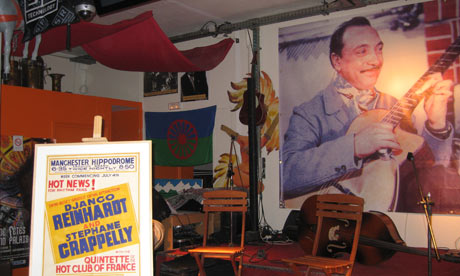 The jazz guitar of Django Reinhardt remains a signature soundtrack of Paris. In the centenary of his birth, Gemma Ware goes in search of the cafes that still swing to his tunes
Paris's temple to Django Reinhardt ... La Chope des Puces in Saint-Ouen. Photograph: Gemma Ware/guardian.co.uk
With its upbeat swing of guitars, violin and the occasional clarinet or saxophone, jazz manouche is the music of Paris's Gypsy periphery that made it to the big time. This year marks the centenary of the birth of legendary guitarist Django Reinhardt and Paris has been paying homage to the inventor of Gypsy jazz.
In the northern 18th arrondissement, near the banlieue of Saint-Ouen where Django's family moved their caravan from Belgium when he was a boy, a square was renamed Place Django Reinhardt in a ceremony to mark his birthday on 23 January. Other centenary celebrations include a performance of the Django 100 group of modern stars of jazz manouche at the Théatre des Champs-Elysées on 14 March and a centenary edition of the Django Reinhardt Festival in June at Samois-sur-Seine, south of Paris.
The clubs where Django made his name with violinist Stéphane Grappelli and their Quintette of the Hot Club of France in the 1930s and 40s have for the most part either shut or turned into more modern jazz venues. Today, in a France where Gypsies remain outcasts, the best manouche musicians – young and old – can still be found on the city's outskirts. But Django's Minor Swing continues to echo across Paris's café-jazz scene every night. Here are a few cafes to watch jazz by.
• 122 rue Rosiers, 93400 Saint Ouen; +33 (0) 1 40 11 02 49. lachopedespuces.com. Jazz manouche every Saturday and Sunday 2pm - 7pm. Metro: Porte de Clignancourt.
In the northern 18th arrondissement, near the banlieue of Saint-Ouen where Django's family moved their caravan from Belgium when he was a boy, a square was renamed Place Django Reinhardt in a ceremony to mark his birthday on 23 January. Other centenary celebrations include a performance of the Django 100 group of modern stars of jazz manouche at the Théatre des Champs-Elysées on 14 March and a centenary edition of the Django Reinhardt Festival in June at Samois-sur-Seine, south of Paris.
The clubs where Django made his name with violinist Stéphane Grappelli and their Quintette of the Hot Club of France in the 1930s and 40s have for the most part either shut or turned into more modern jazz venues. Today, in a France where Gypsies remain outcasts, the best manouche musicians – young and old – can still be found on the city's outskirts. But Django's Minor Swing continues to echo across Paris's café-jazz scene every night. Here are a few cafes to watch jazz by.
La Chope des Puces (Espace Django Reinhardt)
Paris's temple to Django Reinhardt, this bar in Saint-Ouen is near the spot where Django lived - and where he was badly burnt in a caravan-fire in 1928, losing the use of two fingers on his left hand which led to his distinctive jazz phrasing. Next to the Marché aux Puces, the flea and antique market that is a Sunday-afternoon must for visitors, the bar plays host every weekend to the guitarist Ninine Garcia, head of Paris's premier family of jazz manouchists. Fans share tables or stand at the bar sipping espressos and examining the cases of guitars played by former jazz greats on the walls. Behind the tiny bar is a restaurant/concert venue filled with fairground memorabilia that serves a standard French carte on weekends. Backstage is a lutherie (maker of string instruments) and jazz school teaching manouche chord-progressions to Django-wannabees. This great clip from La Chope des Puces 1965 should get you going.• 122 rue Rosiers, 93400 Saint Ouen; +33 (0) 1 40 11 02 49. lachopedespuces.com. Jazz manouche every Saturday and Sunday 2pm - 7pm. Metro: Porte de Clignancourt.


Aucun commentaire:
Enregistrer un commentaire